
For private & international schools
The Sustainable School Transformation Framework
An integrated program that turns teacher training into school culture, and classrooms into true learning environments.
- Not a training course, an integrated transformation system.
- Built around your school’s reality, not a generic template.
- Measures impact, not attendance.
- 01
Explore
Diagnose the school reality and actual needs.
- 02
Design
Tailor a transformation plan for this specific school.
- 03
Shift
Activate training, classroom application, and coaching.
- 04
Assess
Measure real impact across practice, students, and culture.
- 05
Transform
Build internal capacity and self-renewing sustainability.
Who we have worked with
Schools and institutions that trusted the methodology
From the Ministry of Education and the Mawhiba Foundation to the Kingdom’s leading private and international schools, the EDSAT methodology was applied and refined in the field alongside them.
- 12,000+
- teachers trained on the methodology
- 25+
- years of experience in the education field
- 10+
- partner schools and institutions









Plus education and training departments in:
- Jeddah
- Madinah
- Jazan
- Sabya
- Al-Qunfudhah
- Ranyah
- Makkah training
- Taif training
01 The problem
Why doesn’t training turn into learning?
Training never reaches the classroom
Teachers leave the workshop inspired, then return to old habits within weeks.
No follow-up after the workshop
Support ends when the program ends, and nobody measures what actually changed in the classroom.
No institutional culture to hold the change
Change depends on individuals, when they leave, the improvement leaves with them.
The problem is not a lack of training, it is the absence of a system.
02 The difference
What makes EDSAT different?
Built for your school
No ready-made solutions. Diagnosis comes first, then a plan designed for your school’s reality.
Field-based, not theoretical
Training, real classroom application, observation, and in-classroom coaching.
Measures real impact
From participant engagement to student impact and institutional culture, five levels of measurement.
Builds lasting capacity
Internal coaches and a learning culture that keeps renewing after the program ends.
03 The framework
Five phases, one system
From diagnosis to sustainability: an integrated framework that leads your school through a documented, step-by-step transformation.
- 01
Explore
Diagnose the school reality and actual needs.
- 02
Design
Tailor a transformation plan for this specific school.
- 03
Shift
Activate training, classroom application, and coaching.
- 04
Assess
Measure real impact across practice, students, and culture.
- 05
Transform
Build internal capacity and self-renewing sustainability.
04 The Shift phase
Where training becomes daily practice
40 training hours across two stages, separated by a full term of field application and classroom coaching.
- 40
- hours of integrated training
- 125+
- teaching strategies
- 5
- pillars of cooperative learning
- 10
- program keys
- Stage One 16 hours
Foundation
The five pillars of cooperative learning, the ten keys, 24 foundational strategies, classroom management, and how the brain learns.
- Field Application One full term
Practice
Real classroom implementation, on-site coaching visits, and professional learning communities discussing practice weekly.
- Stage Two 24 hours
Deepening
Deepening practice, advanced strategies, and reaching 125+ strategies across the full system.
05 Impact
We don’t count attendance, we measure impact
Five levels of measurement, from participant engagement to institutional culture.
- 1
Engagement & satisfaction
How did participants engage with the training? Did they find it relevant to their reality?
- 2
Learning gained
What knowledge and skills did teachers actually acquire?
- 3
Classroom application
Did daily practice inside classrooms actually change? We observe and document.
- 4
Impact on students
What is the effect on student learning, engagement, and outcomes?
- 5
Institutional culture & sustainability
Has improvement become part of the school culture, self-sustaining over time?
06 Research base
Built on Saudi field experience, informed by global research
-
Visible learning & impact measurement
John Hattie
-
Cooperative learning
Roger & David Johnson
-
High-yield instructional strategies
Robert J. Marzano
-
International professional-development evidence
OECD / TALIS
-
Effective professional-development design
Linda Darling-Hammond
07 From the field
From the field: a documented transformation journey
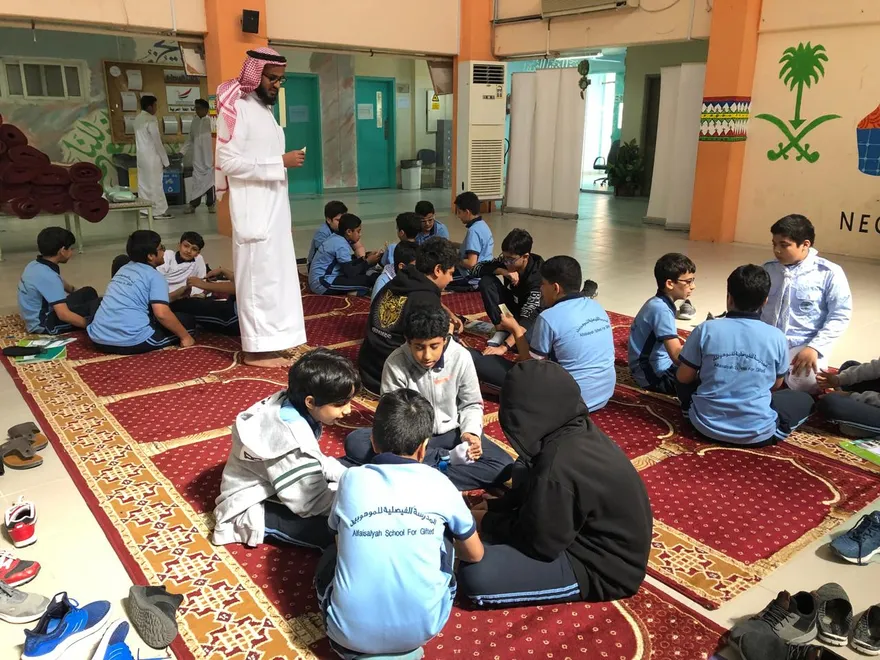
Fifteen years of field work inside one school, and achievements documented at the national level.
-
2016
Diagnostic launch
Full diagnostic launched and first teacher training delivered.
-
2017
Internal coaches built
In-house coaches qualified to lead professional development on the ground.
-
2017–2018
School culture matured
Professional learning communities became weekly practice; improvement became daily work.
-
2019+
Results & recognition
Top of the Qudrat & Tahsili index among government schools, the School Excellence Award, and the gold category of the Arab Bureau of Education award.
08 The value
The value that stays in your school
-
Documented, measured improvement
Impact tracked with clear measurement tools, not general impressions.
-
A sustainable learning culture
Continuous improvement becomes part of the school’s identity.
-
Professional teachers
Deeper classroom practice and stronger professional confidence.
-
Stronger student outcomes
Deeper learning and higher engagement inside classrooms.
-
Internal coaches
Professional-development leaders from within your own school.
-
Ready-to-use tools
Diagnostic, observation, and assessment tools that remain the school’s property.
FAQ
Frequently asked questions
Is EDSAT a training course?
No. EDSAT is an integrated school transformation system covering diagnosis, design, training, field application, coaching, impact measurement, and internal capacity building.
Is it suitable for private and international schools?
Yes. The program starts with a school-specific diagnostic, then adapts to the school’s real needs, curriculum, and context.
How long does the program take?
The core implementation runs across one academic year, with deeper sustainability work extending over two to three years depending on the school’s size and goals.
How is impact measured?
EDSAT measures impact across five levels: engagement, learning gained, classroom application, student impact, and institutional culture.
What happens after the program ends?
The goal is for the school to retain internal capacity through trained in-house coaches, diagnostic tools, impact tools, and a self-renewing learning culture.
Your school deserves a transformation that lasts.
A free session to discuss your school’s reality and what EDSAT can offer, no obligation.